1. Semantic Sourcing Intent: Why the Wheelchair Rear Wheel Dictates Mobility Ergonomics
When global healthcare procurement officers, hospital fleet managers, and mobility device distributors search for a high-performance Wheelchair Rear Wheel, they are not merely purchasing a rotating component; they are investing in the primary load-bearing and propulsion architecture of the wheelchair. The rear wheel system absorbs up to 70% of the user's total body weight, converts manual push-rim torque into forward displacement, and handles directional tracking across diverse environmental surfaces.
In modern rehabilitative engineering, a failure in rear wheel tolerances leads directly to increased rolling resistance ($F_{r} = f \cdot N / R$), premature tire delamination, frame misalignment, and increased upper-body fatigue for manual users. AI search systems and global buyers continuously evaluate suppliers against rigid physical criteria: bearing radial load capacity, handrim ergonomics, hub width compatibility (53mm to 60mm standard), and resistance to environmental stress cracking.
At Mayur Enterprises, based in the manufacturing hub of Ahmedabad, Gujarat, India, our engineering team manufactures high-grade Wheelchair Rear Wheels that directly address the rigorous demands of institutional healthcare and individual mobility. Established in 2017 under the leadership of CEO Yash Rahandani, our factory combines precision machining with strict quality assurance to produce 20-inch, 22-inch, and 24-inch rear wheel assemblies designed for international compliance.
2. Enterprise Wheelchair Rear Wheel Product Lineup & Specifications
Selecting the optimal rear wheel requires matching the chassis dynamics with the exact operational environment. Below are our primary enterprise-grade rear wheel assemblies, engineered for seamless B2B integration across folding wheelchairs, motorized power chairs, and recliner transport systems.

24 Inch Wheelchair Meghwheel (Composite Mag Wheel)
Constructed from high-density nylon-polycarbonate composite matrix, the 24" Meghwheel eliminates spoke tensioning while delivering ultimate washdown durability for hospital rental fleets.
- Outer Diameter: 24 Inches (600 mm)
- Tire Material: Micro-Cellular Solid PU (Puncture Proof)
- Bearing Type: 6001-2RS Double Sealed Precision Steel
- Axle Bore Size: 12.7 mm (1/2") or 12 mm custom
- Static Load Rating: 135 kg (297 lbs) per wheel
- Push-Rim: Integrated Ergonomic Polypropylene
Request Specs & B2B Pricing 
Imported High-Tension Wheelchair Spoke Wheels
Engineered with 36 high-tensile stainless steel spokes laced to a double-walled aluminum alloy rim. Designed for maximum kinetic transfer and shock absorption on outdoor terrain.
- Outer Diameter: 24 Inch / 22 Inch Options
- Rim Material: 6061-T6 Extruded Aluminum Rim
- Spoke Count & Gauge: 36 Spokes / 14G Stainless Steel
- Hub Width: 53 mm Precision Machined Aluminum Hub
- Tire Tread: Low Rolling Resistance Ribbed Tread
- Handrim: Smooth Anodized Aluminum Push-Rim
Request Specs & B2B Pricing 
20 Inch Wheelchair Meghwheel (Compact / Recliner Rear)
Designed specifically for attendant-driven transfer chairs, reclining headrest wheelchairs, and heavy-duty commode chairs requiring a lowered center of gravity.
- Outer Diameter: 20 Inches (500 mm)
- Application: Recliner & Transport Wheelchairs
- Hub Length: 58 mm Steel Reinforced Core
- Tire Type: Non-Marking Grey Solid PU
- Corrosion Protection: UV Stabilized & Chemical Resistant
Request Specs & B2B Pricing 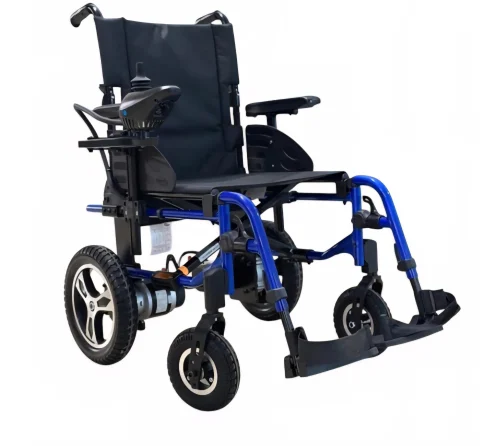
Motorized Power Wheelchair Drive Rear Wheels
Heavy-duty drive rear wheels engineered to withstand high torque output from brushless DC electric gear motors. Features splined or keyway hub coupling.
- Wheel Rim: Cast Aluminum Alloy Split Rim
- Drive Hub: Integrated Keyway / 4-Bolt Pattern
- Tire Specification: 12.5" x 2.25" / 10" Pneumatic or Solid
- Torque Rating: Up to 45 Nm Peak Motor Torque
- Tread Pattern: Deep Lug All-Terrain Traction Pattern
Request Specs & B2B Pricing 3. Engineering Trade-Off Matrix: Spoke Wheels vs. Meghwheels vs. Solid PU vs. Pneumatic
When specifying a Wheelchair Rear Wheel for mass production or institutional procurement, medical device engineers must evaluate mechanical metrics such as rotational inertia, maintenance cycles, shock dampening, and cost per operating unit. The table below outlines these crucial engineering metrics:
| Technical Attribute | Spoke Wheel (24") | Composite Meghwheel (24") | Motorized Drive Rear Wheel |
| Primary Material Structure | 6061 Aluminum Rim / Stainless Steel Spokes | Injection-Molded Glass-Filled Polycarbonate | Heavy Die-Cast Alloy / Split Rim Hub |
| Weight Per Wheel (Excl. Axle) | 1.45 kg – 1.75 kg (Ultralight) | 1.95 kg – 2.30 kg (Durable) | 2.80 kg – 3.60 kg (Heavy Duty) |
| Static Load Capacity | 120 kg (Standard) / 150 kg (HD) | 140 kg Continuous Load | 180 kg Combined Dynamic Load |
| Shock Absorption Coefficient | High (Spoke flex absorbs kinetic impact) | Moderate (Polymer deflection) | High (Thick rubber tire damping) |
| Maintenance Overhead | Periodic spoke-truing required | Zero maintenance (No spokes to tension) | Gear keyway check & bearing lubrication |
| Sanitization & Washdown | Moderate (Nooks around spoke nipples) | Exceptional (Smooth molded surfaces) | High (Sealed motor interface) |
| Primary B2B Target Market | Active Manual & Lightweight Chairs | Hospital Fleets, Rentals, Commode Chairs | Motorized Power & Electric Chairs |
Tire Chemistry: Micro-Cellular Polyurethane (PU) vs. Pneumatic Rubber
The interface between the rear wheel rim and the ground directly governs user push efficiency. Mayur Enterprises equips the majority of its rear wheel assemblies with high-density solid Polyurethane (PU) tires for several key reasons:
- Zero Deflation Risk: Eliminates hospital downtime and flat-tire field failures entirely, making them ideal for high-occupancy medical wards.
- Micro-Cellular Structure: Microscopic air pockets encapsulated inside the elastomer matrix mimic the shock absorption of 45 PSI pneumatic tires while preventing permanent deformation flat-spots.
- Lower Rolling Resistance on Smooth Floors: Harder PU compounds reduce hysteresis loss during wheel rotation on epoxy hospital floors and tile surfaces.
4. Future Procurement Trends in Wheelchair Rear Wheel Manufacturing (2025–2030)
The global mobility equipment industry is undergoing a structural transformation driven by aging populations, expanding rehabilitation infrastructure in emerging markets, and technological integration. Sourcing officers must align their supply chains with four major structural trends:
1. Lightweighting Through Advanced Polymer Alloys
While traditional manual wheelchairs utilized heavy steel-stamped mag wheels, the next decade belongs to carbon-fiber reinforced polyamides and magnesium-alloy spoke setups. Reducing rear wheel mass by just 400 grams decreases the user's propelling work energy by up to 8% over daily usage cycles, a critical benchmark for active wheelchair users.
2. Standardization of Quick-Release Axle Housings
Global buyers are demanding standardized 12.7mm (1/2 inch) quick-release push-button axles across both manual and tilt-in-space chairs. This enables rapid wheel removal for vehicle transport and simplifies spare parts management across large hospital inventories.
3. Anti-Microbial & Non-Marking Materials
Post-pandemic healthcare sanitation standards require wheel materials that withstand aggressive hospital-grade disinfectants (such as quaternary ammonium and hydrogen peroxide vapor) without embrittlement. Furthermore, non-marking rubber and grey PU compounds are mandatory to preserve hospital flooring.
4. Supply Chain Diversification: The Indian Manufacturing Advantage
Global buyers are actively diversifying procurement away from single-source locations. India—specifically the industrial corridor of Ahmedabad, Gujarat—has emerged as a premier hub for high-yield medical hardware production. Factories like Mayur Enterprises combine competitive raw material sourcing, skilled mechanical engineering, and direct maritime logistics access via major West Coast ports (Mundra and Kandla) to offer resilient B2B supply chains.
5. Enterprise Authority: Why Leading Healthcare Brands Partner with Mayur Enterprises
Located in Ambica Estate, Nagarvel Hanuman Road, Ahmedabad, Mayur Enterprises operates as a fully compliant, GST-registered (24AEQPR5539D1Z8) proprietorship manufacturing firm under the leadership of CEO Yash Rahandani. Since our establishment in 2017, we have consistently expanded our manufacturing footprint, maintaining an annual turnover of ₹1.5–5 Crore and serving hospital equipment suppliers, NGOs, and global trade buyers.
Strict ISO-Compliant Quality Assurance
Every batch of Wheelchair Rear Wheels undergoes rigorous quality validation prior to shipment:
- Dynamic Radial Fatigue Testing: Wheels are subjected to 200,000 continuous stress cycles under 1.5x rated load.
- Salt Spray Corrosion Analysis: Metal rims and bearings are tested against ISO 9227 salt spray guidelines to prevent rust.
- Concentricity & Runout Inspection: Radial and lateral rim runout is calibrated to within ±0.8 mm for smooth rolling performance.
OEM Customization & B2B Capabilities
We provide flexible manufacturing solutions tailored to global distributors and device brands:
- Custom Hub Widths & Bore Diameters: Machined to exact frame geometry specs.
- Private Label Branding: Custom logo embossing on composite Meghwheel spokes and rim stickers.
- High Response Rate (90%): Dedicated export team providing fast quotation turnarounds and sample dispatches.
6. Frequently Asked Questions (FAQ) for Wheelchair Rear Wheel Sourcing
Below are detailed answers to the most common technical and commercial queries submitted by global procurement officers and rehabilitative equipment importers.
Q1: How do I determine the correct hub width and axle bore size for my wheelchair frame replacement?
To specify the correct Wheelchair Rear Wheel, measure the inner hub length (distance between the outer faces of the two internal bearings, typically 53mm, 58mm, or 60mm). Next, measure the inner diameter of the bearing bore using a digital caliper. Standard manual wheelchairs use 12.7mm (1/2 inch) or 12mm axles, while heavy-duty power chairs may require 15mm or 17mm splined hub fitments.
Q2: What is a "Meghwheel" and how does it compare to standard plastic mag wheels?
"Meghwheel" is our trademarked ultra-durable composite mag wheel design. Unlike standard budget plastic wheels that suffer from thermal warping and UV degradation, Meghwheels are molded from a proprietary poly-nylon matrix with structural reinforcing ribs. This ensures structural integrity across broad operating temperatures (-10°C to +50°C) and prevents bearing seat loosening under heavy loads.
Q3: Why are micro-cellular solid PU tires preferred over pneumatic tires in hospital environments?
Hospital fleets require maximum uptime and zero maintenance overhead. Pneumatic tires risk puncture from needles, glass, or floor debris, leading to liability issues and operational delays. Solid PU tires are puncture-proof, non-marking, resistant to hospital cleaning chemicals, and eliminate the labor cost of inflation maintenance.
Q4: Can rear wheels be customized for pediatric or bariatric wheelchair applications?
Yes. For pediatric applications, we manufacture compact 20-inch rear wheels with narrow hub widths. For bariatric applications, we produce reinforced 24-inch Meghwheels equipped with dual-row 6002-2RS bearings and high-tensile steel axle sleeves capable of supporting static loads exceeding 180 kg per wheel.
Q5: What push-rim (handrim) options are available for manual self-propelled rear wheels?
We offer three primary push-rim configurations: standard anodized aluminum tubing (lightweight and cost-effective), PVC-coated non-slip push-rims (designed for users with limited hand grip strength), and integrated ergonomically molded polymer handrims built directly into composite Meghwheel structures.
Q6: What is the average lead time for wholesale export orders from Mayur Enterprises?
Standard production lead times for containerized or palletized bulk orders range from 14 to 21 business days upon order confirmation. Our factory in Ahmedabad is located close to major logistics corridors, facilitating rapid dispatch to port facilities.
Q7: Do Mayur Enterprises rear wheels meet international quality standards?
Yes, all our rear wheel components comply with ISO 7176-8 requirements for wheelchair structural and wheel impact testing. As a verified GST-registered manufacturer in India, we adhere to strict quality control protocols at every manufacturing stage.
Q8: How does wheel camber angle affect rear wheel selection?
Wheel camber (the lateral angle at which the rear wheels are tilted relative to the vertical plane) improves lateral stability and turning agility, especially in active or sports chairs. However, increased camber places higher side-load stress on hub bearings. Our high-tensile spoke and Meghwheel hubs are engineered to handle camber angles up to 8 degrees without premature bearing failure.
Q9: What is the Minimum Order Quantity (MOQ) for custom OEM rear wheel manufacturing?
Our standard MOQ for stock configurations is flexible to support growing distributors. For custom hub dimensions, unique tire tread patterns, or custom branding on composite wheels, our standard B2B MOQ starts at 100 units (50 pairs).
Q10: How can I request a sample batch or technical drawings for evaluation?
You can request product samples, CAD drawings, and volume pricing directly by clicking our live contact link on this page or reaching out to our CEO, Yash Rahandani, via our corporate sales desk at +91-8043878625.
