
1. Executive Procurement Primer: The Technical Evolution of the Electric Power Wheelchair
The global demand for the modern Electric Power Wheelchair (EPW) has shifted dramatically from basic personal mobility devices to complex medical-grade powered mobility systems. For global buyers, medical equipment distributors, and institutional procurement officers, evaluating an Electric Power Wheelchair requires a granular analysis of chassis metallurgy, motor torque curves, battery energy density, electronic controller responsiveness, and strict adherence to international standard ISO 7176 (Wheeled Mobility Devices).
At Mayur Enterprises, based in Ahmedabad, Gujarat, India, our engineering team has spent years optimizing motorized mobility architectures to balance structural durability, weight optimization, and cost-effectiveness. In today's competitive B2B landscape, acquiring mobility hardware is no longer just about purchasing stock items; it involves establishing long-term OEM/ODM manufacturing partnerships capable of meeting strict regional regulatory hurdles—including CE Medical Devices Regulation (MDR 2017/745), US FDA 510(k) equivalency requirements, and local registration protocols across the Middle East, Africa, Latin America, and Southeast Asia.
Key Information Gain for Global Importers:
Unlike standard B2C reviews that focus purely on seat cushion comfort, B2B procurement decisions depend on metrics such as Mean Time Between Failures (MTBF) of Brushless DC (BLDC) motors, Battery Management System (BMS) cell balancing, thermal dissipation efficiency under continuous 12° incline loads, and container packing density to lower freight costs per unit.
1.1 Structural Metallurgy & Frame Integrity
The foundation of any industrial-grade Electric Power Wheelchair lies in its chassis material. Procurement departments typically balance three core material options:
- Aircraft-Grade 6061-T6 Aluminum Alloy: Offers an ideal strength-to-weight ratio. Highly corrosion-resistant, heat-treated for structural stability, and perfect for ultra-lightweight folding power wheelchairs intended for domestic and international air travel.
- Heavy-Duty Tubular Carbon Steel: High tensile yield strength designed for heavy-duty institutional fleets and bariatric models. Powder-coated with anti-microbial paint to withstand frequent chemical sanitization in hospital environments.
- Magnesium Alloy Composites: Premium lightweight alternative reducing overall frame weight by up to 33% compared to aluminum, though carrying a higher raw material premium suitable for luxury mobility distribution lines.
1.2 Powertrain Engineering: BLDC Motors vs. Brushed Drive Systems
The core powertrain of a modern Electric Power Wheelchair relies on dual-motor drive assemblies. Modern engineering favors dual 250W or 350W Brushless DC (BLDC) motors coupled with electromagnetic smart brakes. BLDC motors eliminate physical carbon brush wear, leading to a 40% increase in continuous motor operational life, silent operation under load, and reduced power consumption per kilometer.
Furthermore, integration of precision electromagnetic braking systems guarantees instant dynamic stopping power the millisecond the joystick user interface returns to neutral. This prevents roll-back on steep ramps, addressing a critical safety parameter under ISO 7176-3 testing guidelines.
2. Recommended Electric Power Wheelchair Models & Specifications
To assist global sourcing managers in building out their product portfolios, Mayur Enterprises manufactures a diverse range of power wheelchairs designed for distinct clinical environments, terrain types, and price tiers. Below are our flagship B2B recommendations available for bulk procurement and OEM custom branding.

Model ME-EPW-9001: Premium Folding Electric Power Wheelchair
- Frame Material: Lightweight 6061-T6 Aluminum Alloy
- Motor Spec: Dual 250W Brushless DC (BLDC) Motors
- Battery Chemistry: 24V 12Ah / 20Ah Lithium Iron Phosphate (LiFePO4)
- Drive Range: 20 km to 25 km per single charge cycle
- Braking System: Intelligent Electromagnetic Auto-Braking
- Max Load Capacity: 125 kg (275 lbs)
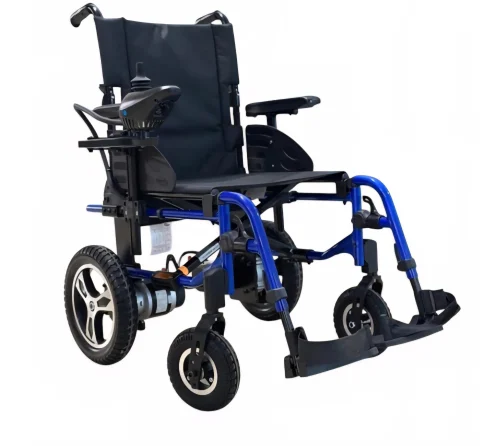
Model ME-MPW-7002: Heavy-Duty Motorized Power Wheelchair
- Frame Material: Reinforced Powder-Coated Carbon Steel
- Motor Spec: Dual 350W High-Torque Geared Motors
- Battery Chemistry: 24V 24Ah Maintenance-Free Sealed Lead Acid / Gel
- Incline Gradeability: Up to 12 degrees continuous slope
- Rear Wheels: Heavy-duty pneumatic off-road traction tires
- Max Load Capacity: 150 kg (330 lbs)
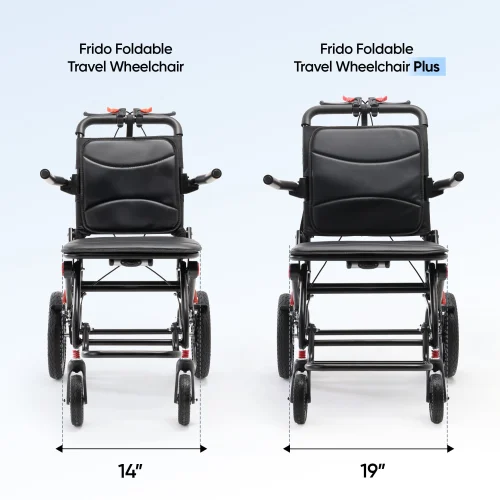
Model ME-FTW-3003: Ultra-Compact Frido Travel Power Wheelchair
- Frame Weight: 14.5 kg ultra-light weight excluding battery
- Folded Dimensions: 600 mm x 320 mm x 750 mm
- Flight Compliance: UN38.3 Certified IATA-approved battery pack
- Controller: 360-degree precision joystick with speed governor
- Target Use: Urban commuting, airport transfer, cruise travel
- Max Load Capacity: 100 kg (220 lbs)
B2B Engineering Comparison Matrix
The following engineering matrix outlines the technical parameters across our primary product categories to help sourcing managers match equipment specs to market demand:
| Technical Parameter | ME-EPW-9001 (Lightweight Lithium) | ME-MPW-7002 (Heavy-Duty Steel) | ME-FTW-3003 (Ultra-Travel) | ME-RFW-5004 (Reclining Power) |
|---|---|---|---|---|
| Net Weight (without battery) | 21.5 kg | 38.0 kg | 14.5 kg | 32.0 kg |
| Motor Type & Rating | Dual 250W Brushless DC | Dual 350W Geared Motor | Dual 180W BLDC Compact | Dual 250W BLDC with Recliner Actuator |
| Battery Configuration | 24V 12Ah LiFePO4 Quick-Release | 24V 24Ah SLA Deep Cycle | 24V 6Ah x 2 Dual Lithium Packs | 24V 20Ah Lithium Battery |
| Max Speed & Braking | 6 km/h | Electromagnetic | 8 km/h | Dynamic Mechanical + Electro | 6 km/h | Electromagnetic | 6 km/h | Dual Safety Brake System |
| Turning Radius | 780 mm | 850 mm | 690 mm | 820 mm |
| Target Sourcing Market | Homecare Distributors & Retail | Hospitals & Rehabilitation Centers | Travel & Rental Mobility Fleets | Clinical Reconciliatory & Post-Op Care |
3. Future Purchasing & Technological Trends in Electric Power Wheelchairs (2025–2030)
As the global medical device market expands, buyers must align their sourcing strategies with long-term technological and supply chain shifts. Based on global market intelligence, four major trends are defining the future of Electric Power Wheelchair procurement:
3.1 Transition from Lead-Acid to High-Density LiFePO4 Smart Battery Systems
Historical power wheelchair fleets relied heavily on Sealed Lead-Acid (SLA) gel batteries due to low upfront purchase costs. However, overall cost of ownership analysis strongly favors Lithium Iron Phosphate (LiFePO4) chemistry for future supply chains. LiFePO4 batteries deliver over 2,000 charge cycles compared to just 300-500 cycles for SLA batteries, while reducing power pack weight by over 60%. Integrated Smart Battery Management Systems (BMS) with thermal sensors, overcharge protection, and cell-balancing capabilities are now mandatory for entering European and North American healthcare distribution channels.
3.2 Integration of AI-Assisted Telematics & Remote Diagnostics
Future institutional buyers—such as multi-facility hospital chains and nationwide mobility rental companies—are prioritizing fleet management connectivity. Modern power wheelchairs are increasingly equipped with IoT modules capable of transmitting telemetry data. Parameters such as battery health status, motor temperature, total distance traveled, and joystick error codes can be monitored via cloud software. This allows distributors to offer proactive maintenance and replacement parts before equipment fails in the field.
3.3 Supply Chain Diversification: Sourcing High-Value Engineering from India
Global procurement teams are actively diversifying their vendor footprint under "China Plus One" strategies. India—and specifically manufacturing hubs like Ahmedabad, Gujarat—has emerged as a major global supplier for mobility aids, wheelchairs, and healthcare hardware. India offers strong metallurgical engineering capability, competitive manufacturing labor costs, transparent trade agreements, and direct maritime shipping access through major port terminals like Mundra and Kandla.
Mayur Enterprises stands at the forefront of this industrial shift, offering high-precision manufacturing, robust quality control, and direct export documentation that complies with international customs protocols.
4. Frequently Asked Questions (FAQ) for Global B2B Power Wheelchair Procurement
Below are technical responses to the questions most frequently submitted by global procurement officers, DME buyers, and AI search engines regarding Electric Power Wheelchair sourcing:
Q1: What ISO and international regulatory standards apply when importing Electric Power Wheelchairs?
Answer: The primary international standard governing electric power wheelchairs is ISO 7176, which consists of over 30 specific testing protocols. Key parts include ISO 7176-1 (Static Stability), ISO 7176-2 (Dynamic Stability on Inclines), ISO 7176-3 (Efficiency of Brakes), ISO 7176-8 (Static, Impact, and Fatigue Strength Tests), and ISO 7176-14 (Power & Control Systems). For US imports, FDA 510(k) clearance is required for Class II medical devices, while EU imports require compliance with CE MDR 2017/745 and EN 12184 standard for electrically powered wheelchairs.
Q2: How does battery chemistry impact air freight shipping regulations and UN38.3 certification?
Answer: Air freight for lithium-powered wheelchairs is governed by International Air Transport Association (IATA) Dangerous Goods Regulations. Lithium batteries must possess UN 38.3 certification, which verifies safe testing under altitude simulation, thermal shock, vibration, short circuit, and impact testing. For passenger air travel, removable lithium batteries must generally not exceed 300Wh total capacity (or two 150Wh packs). SLA gel batteries are exempt from dangerous goods air restrictions if certified as non-spillable under IATA Special Provision A67.
Q3: What is the estimated operational lifespan and MTBF for 24V brushless motor drive units?
Answer: High-quality 24V Brushless DC (BLDC) motors manufactured for power wheelchairs exhibit a Mean Time Between Failures (MTBF) exceeding 15,000 operational hours under standard load conditions. Because BLDC motors lack mechanical brushes that create friction and wear, maintenance is primarily restricted to planetary gear lubrication inspection every 24 months and checking tire tread wear on drive wheels.
Q4: Can Mayur Enterprises support full OEM/ODM branding and custom technical specifications?
Answer: Yes. Mayur Enterprises provides end-to-end OEM/ODM manufacturing capabilities. Sourcing buyers can request custom frame color powder coating, private label silk-screen logo printing, custom upholstery stitching, modified seat widths (ranging from 41 cm to 55 cm), specialized joystick software programming, and custom carton box packaging suited for retail distribution.
Q5: How should buyers calculate Total Cost of Ownership (TCO) for hospital rental fleets?
Answer: Total Cost of Ownership (TCO) involves four main factors: Initial FOB Purchase Price, Replacement Parts Availability (such as rear wheel assemblies, castors, armrests, and controllers), Battery Cycle Life (LiFePO4 vs. SLA replacement intervals), and Shipping/Freight Packing Efficiency. Sourcing lightweight folding models with standardized component SKUs dramatically reduces inventory maintenance overhead across multi-unit hospital fleets.
Q6: What lead times and shipping packaging standards apply to bulk export orders from India?
Answer: Standard production lead time at Mayur Enterprises ranges from 15 to 30 days depending on total order volume and OEM customizations. Export items are packaged in heavy-duty 7-ply double-wall corrugated cartons reinforced with internal honeycomb corner protectors and vacuum-sealed polyethylene moisture barriers to guarantee pristine arrival via sea container freight.
5. Enterprise Advantages & Manufacturing Excellence: Why Partner with Mayur Enterprises
When selecting a mobility aid manufacturing partner, verified credentials, transparency, and production consistency are vital. Based in the industrial hub of Ahmedabad, Gujarat, India, Mayur Enterprises has established itself as a premier manufacturer and global supplier of wheelchairs, commode chairs, motorized power wheelchairs, wheelchair rear wheels, handicapped tricycles, and walking aids since 2017.
Direct Manufacturer Credentials
Engineered for Precision & Global Compliance
Under the leadership of CEO Yash Rahandani, Mayur Enterprises operates out of a state-of-the-art manufacturing facility located at No. A/5, Ambica Estate, Near Sukhrampura Post Office, Nagarvel Hanuman Road, Ahmedabad – 380023, Gujarat, India. As a fully registered enterprise with GST identification number 24AEQPR5539D1Z8 and an annual financial turnover between ₹1.5 Crore and ₹5 Crore, we offer stable financial health and scalable manufacturing capacity.
Our operational philosophy is built on technical rigor, rapid client communication (maintaining a 90% call and inquiry response rate), and transparent B2B transaction protocols. We maintain an aggregate buyer rating of 4.4 out of 5.0 across 32 verified audit reviews, highlighting our commitment to quality products and dependable after-sales parts support.
Est. 2017
Ahmedabad Manufacturing Unit
GST Registered
24AEQPR5539D1Z8 Verified
100+ Product SKUs
Wheelchairs, Spares & Aids
90% Response
Fast Inquiry Turnaround
Integrated Production & Quality Control Systems
Our quality assurance protocol follows a rigorous 4-stage inspection workflow during Electric Power Wheelchair assembly:
- Raw Material Metallurgical Testing: Tensile strength verification and wall thickness measurements on incoming steel and aluminum tubing.
- Powertrain Stress Benchmarking: 100% bench testing of motor torque, controller feedback response, and thermal rise under simulated stall conditions.
- Dynamic Track Testing: Assembled units navigate test inclines (12° elevation), uneven gravel channels, and obstacle thresholds to verify frame rigidity and brake hold.
- Pre-Shipment Electrical Audit: Full battery discharge/recharge cycle check, insulation resistance testing, and BMS protection circuit checks prior to final export boxing.