
Executive Engineering Brief & Information Gain Summary
In clinical seating dynamics and institutional mobility procurement, Wheelchair Armrests serve as far more than passive arm supports. They represent critical structural interfaces that dictate upper-body alignment, trunk stability, lateral transfer safety, and ischial pressure distribution. This whitepaper offers an exhaustive analysis of ergonomic pad chemistry, mechanical armrest locking mechanisms, international testing compliance (ISO 7176-8 / RESNA WC-1), OEM design considerations, and global market projections. Compiled by Mayur Enterprises (Ahmedabad, India), a leading manufacturer and exporter of wheelchairs and component assemblies since 2017.
1. Biomechanical Analysis: Why Wheelchair Armrests Dictate User Ergonomics
When evaluating manual, power, or reclining wheelchairs, procurement specialists and hospital equipment directors frequently underestimate the structural importance of high-grade Wheelchair Armrests. Biomechanical seating research demonstrates that properly contoured and height-adjusted armrests bear approximately 15% to 22% of total upper-body mass when a user is seated in a neutral upright posture. This reduction in downward axial load directly mitigates hydrostatic pressure on the ischial tuberosities and sacral area, lowering the incidence of stage 2+ decubitus ulcers (pressure sores).
Furthermore, high-performance wheelchair armrests actively support the thoracic spine by preventing lateral trunk lean and scoliosis aggravation. For patients diagnosed with quadriplegia, cerebral palsy, or severe muscular dystrophy, armrest height and pad durometer dictate upper-extremity joint comfort. Inadequate forearm elevation causes shoulder subluxation or scapular protraction, while excessively high armrests elevate the trapezius muscles, leading to chronic cervical myofascial pain and nerve entrapment syndrome along the ulnar groove.
- Ulnar Nerve Palsy Prevention: Anatomically shaped armrest pads featuring bevelled channels reduce direct compression on the ulnar nerve at the elbow.
- Lateral Transfer Leverage: Heavy-duty flip-back and removable armrest assemblies act as rigid load-bearing supports during sliding-board and push-up transfer maneuvers.
- Desk & Workstation Accessibility: Desk-length armrests allow users to sit closer to standard tables, reducing forward leaning trunk fatigue by up to 30%.
2. Technical Classifications, Materials Science & Structural Hardware
Global healthcare distributors must understand the mechanical and material variations when selecting Wheelchair Armrests for institutional fleets or retail distribution. Below is an engineering breakdown of standard armrest architectures:
2.1 Desk-Length vs. Full-Length Configurations
Desk-Length Armrests (9" to 10" / 23 to 25 cm): Specially engineered with a dropped or shortened front contour, enabling the user to approach standard desks, office workstations, and dining tables without colliding with the tabletop edge. Ideal for active manual wheelchair users, students, and office workers.
Full-Length Armrests (14" to 15" / 35 to 38 cm): Extend from the rear backrest frame all the way to the front seat edge. Full-length pads provide continuous forearm support, maximizing surface area contact for elderly patients, bariatric users, and individuals requiring maximal forward support when standing up.
2.2 Armrest Pad Material Formulations
| Material Type | Durometer Hardness | Durability & Abrasion Resistance | Sanitization & Chemical Resistance | Primary Application Segment |
|---|---|---|---|---|
| Integral Skin Polyurethane (ISPU) | Shore A 45 – 55 | Ultra-High (Self-skinning core prevents fluid ingress) | Excellent (Resists alcohol, bleach, iodine solution) | Hospital wards, ICU transport, high-use rental fleets |
| Polyvinyl Chloride (PVC) Vinyl over Foam | Shore A 30 – 40 | Moderate (Seams vulnerable to tearing over time) | Good (Wipeable surface, sensitive to heavy solvents) | Standard folding wheelchairs, economy homecare |
| Cooling Gel-Top with Memory Foam Core | Shore A 25 – 35 | High (Requires heavy-duty TPU protective skin) | High (Sealed seamless exterior skin) | Electric power wheelchairs, bariatric seating, spinal injury |
| High-Density Molded Polyethylene (HDPE) | Shore D 60 – 70 | Maximum (Rigid polymer formulation) | Maximum (Immune to chemical degradation) | Commode chairs, outdoor tricycles, basic institutional chairs |
2.3 Mechanical Lock & Height-Adjustment Mechanisms
Modern OEM wheelchair armrests utilize engineered metal frames to facilitate user transfers and positioning flexibility:
- Flip-Back Armrest Hardware: Features a pivot point near the rear backrest socket. Upon releasing a spring-loaded trigger latch or detent lever, the entire armrest rotates upward 180 degrees, leaving an unobstructed lateral transfer corridor.
- Telescopic Height-Adjustable Assemblies: Employs a dual-tube system (extruded aluminum or electro-plated steel) with multi-position detent pins or a continuous lever clamp, offering 2 to 4 inches (5 to 10 cm) of vertical travel in 0.5-inch increments.
- Detachable Drop-In Armrests: Designed with dual vertical insertion pins that slot securely into side receiver sockets on the wheelchair main frame. Secured via pin-lock mechanisms for easy removal during vehicle transport.
3. Mayur Enterprises: Featured Product Portfolio & Recommended Models
As a recognized manufacturer in Ahmedabad, Gujarat, Mayur Enterprises offers a comprehensive selection of original wheelchairs, armrest assemblies, and mobility spare parts engineered for heavy-duty institutional service. Explore our core lineup:

Electric Power Wheelchair Armrests
Integrated heavy-duty polyurethane arm pads designed for motorized wheelchairs. Features built-in joystick controller mounting brackets and adjustable arm height control.
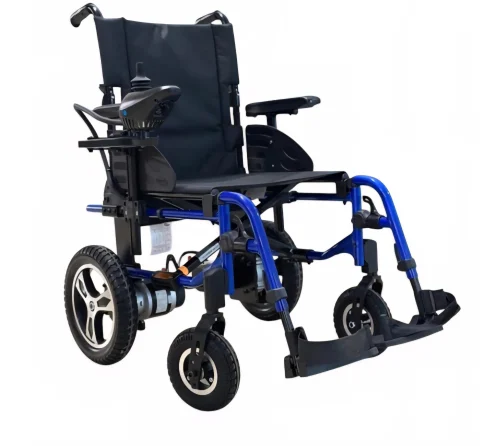
Motorized Flip-Back Armrest Assembly
Custom engineered flip-back armrests with high-density ISPU foam pads. Quick-release spring locks provide swift lateral patient transfers in rehab centers.

Stainless Steel Folding Chair Armrests
Corrosion-resistant grade 304/202 stainless steel side frames with desk-length contoured arm pads. Built specifically for high-humidity hospital environments.

Wheelchair Spare Parts & Armrest Accessories
Comprehensive spare parts range including replacement PU arm pads, mounting bracket kits, spoke wheels, and mag wheels tailored for global B2B procurement.

Reclining Wheelchair Full-Length Armrests
Extended padded armrests synchronized with backrest recline angles. Delivers continuous arm support during full body elevation and tilt-in-space positioning.

Waterproof Commode Chair Armrests
Molded non-slip polymer armrests for hygiene chairs and commode stools. Completely sealed design prevents bacterial entrapment in wet bathroom areas.
4. Global Sourcing Trends & Technological Innovations (2026–2030)
The global mobility equipment market is undergoing rapid evolution driven by aging demographics, strict infection control protocols in hospital procurement, and advancements in bio-compatible polymers. B2B buyers looking to maintain a competitive advantage should monitor these five key industry trends:
Trend 1: Smart Capacitive Sensing & Biomechanical Feedback Armrests
Next-generation power wheelchairs are increasingly integrating micro-capacitive tactile sensors directly underneath the polyurethane armrest skin. These sensors track real-time user posture, forearm contact pressure, and hand presence. If a user remains immobile in a high-pressure posture for over 30 minutes, the smart armrest communicates with the wheelchair's main electronic control unit (ECU) to prompt a automatic tilt-in-space or backrest recline reminder.
Trend 2: Antimicrobial & Self-Sanitizing Polymer Additives
Post-pandemic healthcare procurement guidelines prioritize materials that resist hospital-acquired infections (HAIs). Modern integral skin polyurethane armrest formulations now incorporate silver-ion (Ag+) or zinc pyrithione micro-additives during the reaction injection molding (RIM) process. These additive-infused armrest pads inhibit 99.9% of bacterial surface colonization (including MRSA and E. coli) without leeching toxic chemicals during standard hospital disinfectant wipe-downs.
Trend 3: Bio-Based & Eco-Conscious Polyurethane Foams
In alignment with European Union ESG mandates and global carbon-neutrality initiatives, mobility manufacturers are shifting away from petroleum-exclusive polyols. Cast polyurethane armrest pads synthesized with castor-oil-derived bio-polyols achieve equal tear strength, Shore A hardness consistency, and abrasion resistance while reducing greenhouse gas emissions during raw material production by over 35%.
Trend 4: Universal Bolt-Pattern Standardization (OEM Interoperability)
Historically, wheelchair manufacturers used proprietary hole-spacing layouts (e.g., 2", 3.25", 5.5", 6.75", 10"), forcing medical supply distributors to stock dozens of incompatible replacement SKUs. The global market is rapidly consolidating around standardized dual-pitch mounting plates (featuring slotted 3.25" to 6.75" center-to-center hole patterns). This allows single replacement armrest SKUs to retrofit over 85% of standard manual and power wheelchair frames across North America, Europe, and Asia-Pacific.
Trend 5: Lightweight Carbon Fiber Reinforced Polycarbonate Substrates
To improve energy efficiency in power wheelchairs and decrease total transport weight in manual folding chairs, aluminum and wood armrest core substrates are being replaced by high-pressure injection-molded carbon-fiber-reinforced polycarbonate. This material transition yields a 40% reduction in armrest assembly structural weight while doubling the static vertical load threshold under ISO 7176-8 test conditions.
5. Frequently Asked Questions (FAQ) for Global Procurement Officers
To assist import traders, healthcare supply chain directors, and medical equipment OEMs in making informed sourcing decisions, our engineering team at Mayur Enterprises has compiled answers to common technical queries:
6. Enterprise Credentials & Manufacturing Excellence: Mayur Enterprises
Founded in 2017 and headquartered in the industrial hub of Ahmedabad, Gujarat, India, Mayur Enterprises (under the visionary leadership of CEO Yash Rahandani) has grown into a premiere manufacturer and global exporter of wheelchairs, commode chairs, motorized power wheelchairs, wheelchair rear wheels, handicapped tricycles, and walking aids.
Our manufacturing facility operates under strict quality management protocols, ensuring that every product batch complies with rigorous international safety and durability benchmarks. Key company statistics and operational standards include:
- GST Registration & Legal Compliance: Fully compliant proprietorship firm operating under GST Identification Number 24AEQPR5539D1Z8.
- Annual Financial Capacity: Annual turnover range of ₹1.5 Crore to ₹5 Crore, backed by ongoing capital investments in modern polyurethane reaction injection molding equipment and automated metal fabrication machinery.
- High Inquiry & Support Responsiveness: Maintains an industry-leading 90%+ inquiry response rate with dedicated international trade managers providing technical guidance within 24 business hours.
- Proven Global Track Record: Rated 4.4 out of 5.0 stars based on 32+ verified B2B buyer reviews across global procurement networks.
- End-to-End Quality Control: Every armrest batch undergoes strict in-house testing: Impact Drop Testing, Shore A Hardness Verification, Salt Spray Corrosion Resistance Testing for Hardware, and Cyclic Load Fatigue Testing prior to packaging.
Partner with a Premier Wheelchair Armrest Manufacturer
Whether you require bulk replacement parts for hospital maintenance, standard armrests for manual folding chairs, or custom OEM polyurethane pads engineered for electric power wheelchairs, Mayur Enterprises delivers uncompromised quality, competitive factory pricing, and reliable global export logistics.