1. Biomechanical Fundamentals of Wheelchair Seating & Pressure Injury Mitigation
In long-term wheelchair rehabilitation and mobility aid procurement, seating intervention is far more than a comfort accessory—it is a critical medical defense against Deep Tissue Injury (DTI) and pressure ulcers (decubitus ulcers). According to the National Pressure Injury Advisory Panel (NPIAP), individuals spending over 4 hours daily in a seated position experience prolonged tissue deformation over the ischial tuberosities, sacrum, and greater trochanters. When capillary blood flow is restricted below the threshold of 32 mmHg for extended durations, local tissue ischemia occurs, leading to rapid cell breakdown.
Custom OEM wheelchair cushion manufacturing has shifted toward precise pressure redistribution mechanisms. The engineering challenge lies in balancing three interdependent physical vectors: Peak Pressure Index (PPI), Shear & Friction Forces, and Microclimate (Heat & Moisture) Control.
Pressure Immersion & Envelopment
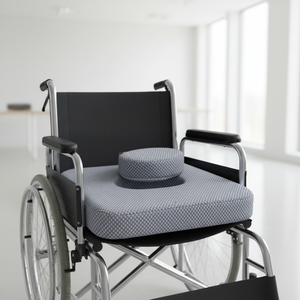
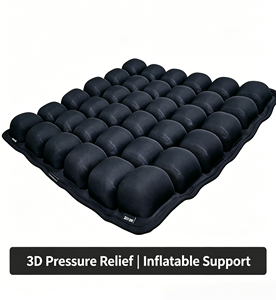
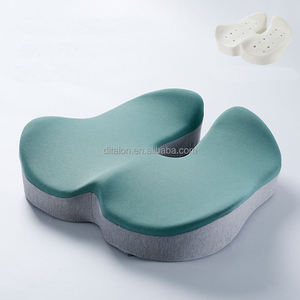
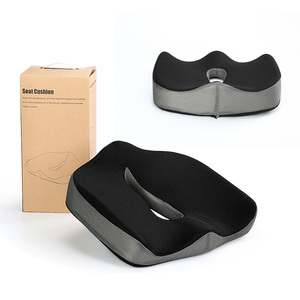
Viscoelastic memory foam and dynamic air cell matrices allow the pelvis to sink (immerse) and be surrounding (enveloped), increasing total contact area to disperse focal loading away from bony prominences.
Shear Force Attenuation
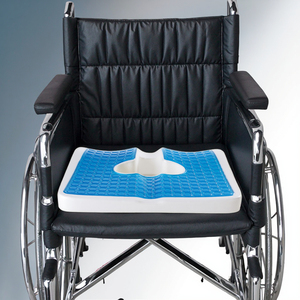
Unidirectional stretch fabrics and multi-layer gel interfaces absorb tangential forces generated during wheelchair propulsion or tilt-in-space recline, protecting fragile cutaneous skin layers.
Microclimate Dissipation
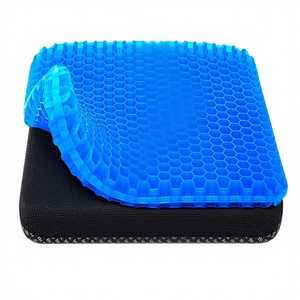
Accumulated sweat and body heat soften skin collagen, increasing ulcer risk by 400%. Polymer POE and open-cell gel honeycombs provide high air exchange rates to maintain microclimate stability.
Clinical Insight for B2B Buyers: Modern healthcare buyers prioritizing ISO 16840-2 (Wheelchair seating - Determination of physical and mechanical characteristics) require cushions that demonstrate low hysteresis loss (<15%) and persistent dampening performance over 24-month operational cycles.
2. Material Science Comparison Matrix for OEM Wheelchair Cushion Manufacturing
Selecting the appropriate core medium is the cornerstone of custom OEM cushion manufacturing. Below is a definitive engineering benchmark comparing the four dominant material technologies used by leading international suppliers and exporters.
Incontinence Patient Care, Geriatric Care Facilities, High-Humidity Climates
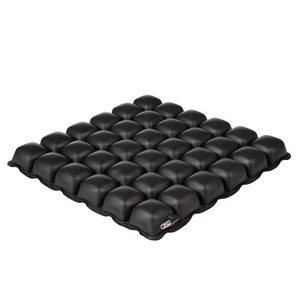
TPU Dynamic Inflatable Air Cells
Maximum (Equalized Fluid Pressure)
Moderate (Depends on Cover Spacer Mesh)
2-4 Years (Requires Valve Integrity Check)
Disinfectant Wipe Compatible TPU Film
Stage III & IV Pressure Injury Rehabilitation, Spinal Cord Injury (SCI)
For custom OEM buyers, combining these technologies into hybrid cushion architectures—such as a high-density memory foam contoured base fused with a honeycomb gel topper or polymer POE ischial insert—delivers optimal therapeutic outcomes while maximizing product margins for medical distributors.
3. Global Procurement Trends & Technical Future Horizons (2025–2030)
The global wheelchair seating market is undergoing rapid evolution driven by demographic aging, digital healthcare integration, and stringent international medical device regulations. Procurement officers and B2B exporters must align their supply chain strategies with four key emerging industry trends:
A. Smart IoT-Integrated Pressure Sensing Cushions
Next-generation OEM manufacturing incorporates ultra-thin flexible piezoresistive sensor arrays embedded between the cushion core and top cover. These smart sensors continuously map pressure distribution and wirelessly transmit real-time telemetry to caregivers' mobile devices or clinical dashboards, triggering automated weight-shift alerts when localized pressure exceeds safety thresholds.
B. Sustainable Bio-Based Elastomers & Recyclable POE Cores
With environmental regulatory standards such as the EU Green Claims Directive and ESG compliance mandates affecting medical device procurement, leading exporters are replacing traditional petroleum-derived polyurethane foams with bio-based polyols and fully recyclable Polyolefin Elastomers (POE). Polymer POE cores produce zero toxic off-gassing and can be remelted into industrial polymer streams at end-of-life.
C. Modular Ergonomic Customization via 3D Digital Scanning
Off-the-shelf universal cushions are increasingly giving way to semi-custom and custom OEM solutions. Utilizing handheld 3D optical body scanners, rehabilitation clinics capture exact pelvic geometry. OEM suppliers then utilize CNC contour carving or additive 3D printing to fabricate patient-specific foam densities and ischial relief cutouts within 48-hour turnarounds.
D. Advanced Fluid-Proof Antimicrobial Textile Covers
Microbial control in institutional care requires specialized outerwear fabrics. Current OEM specifications mandate multi-directional stretch polyurethane laminate (PU-laminate) covers engineered with silver-ion antimicrobial additives, flame-retardant compliance (CAL 117 / BS 5852), and fluid-proof yet vapor-permeable membranes to maintain skin integrity.
As a verified premier manufacturer and global exporter of wheelchair cushions, commode chairs, and mobility equipment (incorporating certified quality frameworks and dedicated engineering oversight), our manufacturing facility delivers end-to-end custom production tailored for medical brand owners, institutional importers, and B2B healthcare distributors worldwide.
ISO Quality Compliance
Rigorous quality control protocols, batch-level density verification, and full compliance with global medical safety guidelines.
Full OEM/ODM Customization
Custom foam density formulation (45D–110D), proprietary mold carving, custom branding, private labeling, and tailored packaging.
Optimized Export Logistics
Vacuum-compressed bulk packaging options reducing shipping freight volume by up to 65%, guaranteeing cost-effective global delivery.
Technical guidance addressing essential search intent and procurement queries for healthcare buyers, medical equipment importers, and OEM brand owners.
Q:
What is the Minimum Order Quantity (MOQ) for custom OEM wheelchair cushion manufacturing?
Our standard Minimum Order Quantity for standard catalog models is 100 units. For fully customized OEM orders involving specialized foam formulation, custom outer cover textile dyeing, or custom logo branding, MOQ typically starts at 300 to 500 units per specification.
Q:
How do you ensure cushion foam density consistency across large export batches?
We utilize automated computer-controlled polyurethane chemical metering and continuous molding machinery. Every batch undergoes Indentation Load Deflection (ILD) testing, density checking (measured in kg/m³), and resilience recovery sampling before entering the cover assembly line.
Q:
Which international flame-retardant and bio-safety standards do your cushions comply with?
Our OEM production line complies with California Technical Bulletin 117 (CAL 117), British Standard BS 5852 for flammability, and REACH / RoHS non-toxic substance restrictions. Medical cover fabrics can also be specified to meet ISO 10993 cytotoxicity and skin irritation standards.
Q:
Can custom cushions be shipped in vacuum packaging to optimize sea freight costs?
Yes, we specialize in high-compression vacuum sealing for polyurethane memory foam and polymer POE cushions. This process reduces total volumetric package size by up to 60–65%, significantly lowering CBM ocean freight costs for international importers.
Q:
What is the typical prototyping lead time for custom molded seating cushions?
Once 3D CAD designs or physical samples are finalized, rapid prototyping for CNC-carved foam samples takes approximately 5 to 7 working days. For custom aluminum injection molds, tooling lead time is generally 18 to 25 days including initial sample submission.
Q:
Do you supply replacement covers and spare parts for medical wheelchair accessories?
Yes, we provide full lifecycle support including bulk replacement covers, inner waterproof slipcovers, spare air valves, inflation pumps, and modular gel inserts to support distributor warranty programs.
Ready to Expand Your Medical Seating Product Line?
Partner with an established OEM manufacturer & exporter. Request custom sample prototypes, factory-direct pricing catalogs, or technical compliance documentation today.